
Free Will, Karma, and the Wisdom of Detachment

The Nature of Free Will in Vedic Philosophy
Free will, as understood through the lens of Vedic wisdom, is a profound yet bounded gift. It is not absolute, nor is it absent; it exists in a delicate balance, accounting for roughly half of the forces that shape our lives. This 50% of free will grants us the sacred power to make choices, to strive, to evolve, and to chart the course of our inner and outer journey. Yet the remaining half belongs to something deeper and older than our present existence, the accumulated weight of our karma across lifetimes.
The Three Layers of Karma
To understand why effort does not always yield the desired result, we must first understand how karma operates across three distinct dimensions:
Sanchit Karma is the vast reservoir of all actions, intentions, and experiences accumulated across every lifetime a soul has lived. It is the grand cosmic ledger, immense, ancient, and largely unseen by our conscious mind.
Prarabdh Karma is the portion of that reservoir that has been "activated" for this lifetime; the specific seeds that have already been planted and are now in the process of bearing fruit. These are the circumstances of our birth, the nature of certain relationships, the health conditions we carry, the inexplicable joys and sorrows that visit us seemingly without cause. Prarabdh is already in motion. It cannot be washed away or overridden by sheer willpower alone.
Kriyaman Karma is what we are creating right now; through every thought, word, and deed. This is the domain where free will operates most powerfully, where our daily choices add to or subtract from our karmic inheritance.
Why Effort Alone Doesn't Always Bring Results
This is perhaps the most misunderstood dimension of spiritual life and also the source of great frustration for sincere, hardworking souls.
Many people find themselves doing everything right, putting in tremendous effort, holding pure intentions, maintaining discipline and focus, and yet the desired outcome remains elusive. Goals feel just out of reach. Doors open partially, then close. Progress comes in waves, only to recede. Over time, this inexplicable gap between effort and result can quietly erode a person's enthusiasm for life itself.
What is missing from this picture is the understanding of Prarabdh karma. Certain outcomes are simply not destined to manifest until the right alignment of time, place, circumstance, and karmic ripeness comes together. The universe is not indifferent to our efforts, it is, in fact, patiently orchestrating a far more complex unfolding than our limited perspective can perceive. Our free will plants the seeds, but Prarabdh determines the season of the harvest.
This is not fatalism. It is a sophisticated understanding of causality that operates across multiple dimensions simultaneously.
The Wisdom of Detachment — Bhagavad Gita's Timeless Teaching
It is precisely because of this layered reality that Shri Krishna offers one of the most radical and liberating teachings in the Bhagavad Gita:
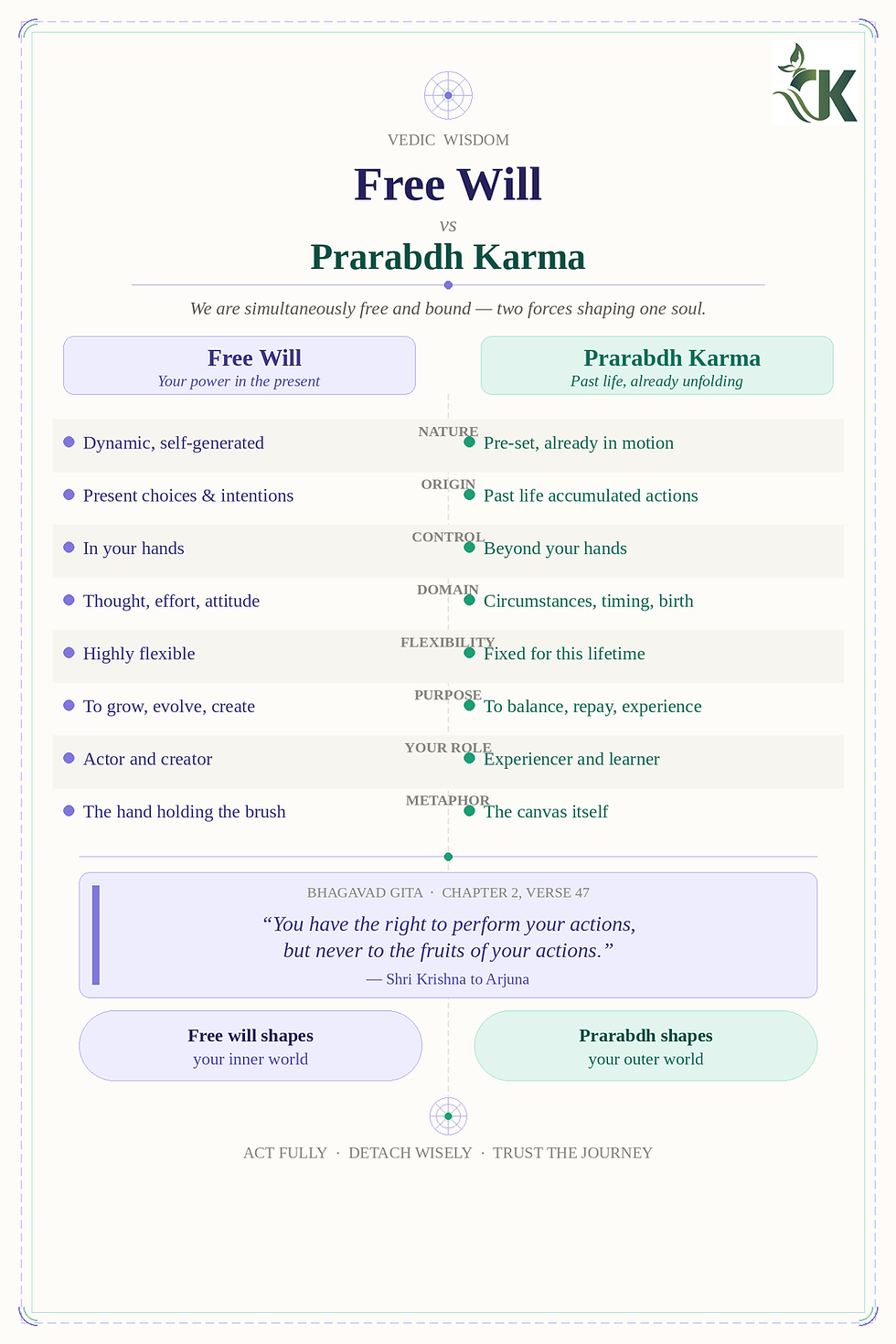
"You have the right to perform your actions, but never to the fruits of your actions." — Bhagavad Gita, Chapter 2, Verse 47
This is not a call to passivity or indifference. On the contrary, Krishna urges Arjuna to act with full force, complete dedication, and unwavering sincerity. What He counsels against is the attachment to outcomes, the psychological and emotional merger of one's sense of self with the result.
When we are deeply attached to a specific outcome, every delay becomes a defeat, every obstacle becomes a crisis, and every unanswered prayer becomes a reason to lose faith. But when we act from a place of inner freedom, giving our very best while remaining open to whatever the universe returns, we are no longer at the mercy of circumstances. We become instruments of a higher intelligence.
Detachment, in this sense, is not distance. It is freedom in action.
Free Will vs. Prarabdh Karma
The Core Distinction
At the heart of Vedic philosophy lies a beautiful paradox; we are simultaneously free and bound. Free will and Prarabdh karma are not opposites at war with each other. They are two complementary forces, like the banks of a river. The river flows freely, yet it is shaped and directed by the banks it cannot see beyond.
Side-by-Side Comparison
Dimension | Free Will | Prarabdh Karma |
Nature | Dynamic, self-generated | Pre-set, already in motion |
Origin | Present choices and intentions | Past life accumulated actions |
Control | In your hands | Beyond your hands |
Domain | Thought, effort, attitude, response | Circumstances, timing, relationships, health |
Flexibility | Highly flexible | Fixed for this lifetime |
Purpose | To grow, evolve, and create | To balance, repay, and experience |
Timeframe | Present and future | Already activated from the past |
Can it be changed? | Yes, every moment | Only softened through grace and spiritual practice |
The Tension Between Ancient Wisdom and Modern Science
Here lies one of the most fascinating intellectual tensions of our time.
The modern world, built on the foundations of empirical science, operates on the principle of cause and effect as a closed, linear system. Set a goal, design a strategy, execute the plan, measure the result. Link every action to an outcome. Optimise relentlessly. This model has given humanity extraordinary achievements in medicine, technology, and human capability.
Yet this same model, when applied to the inner life without spiritual wisdom, can become a source of immense suffering. It tells us that if we are not getting results, we must be doing something wrong. It trains us to chase outcomes with ever-increasing urgency, measuring our worth by what we achieve rather than who we are becoming.
The Vedic worldview does not reject effort; it elevates it. It simply situates effort within a larger, multi-dimensional framework of time, karma, grace, and cosmic intelligence. It asks us to trust not just the process we can see, but also the one we cannot.
Living in the Balance
The invitation, then, is to hold both truths simultaneously, to be as disciplined and purposeful as the most driven modern achiever, while remaining as surrendered and at peace as a deeply rooted spiritual practitioner.
Use your free will fully. Make the effort, cultivate the intention, show up with sincerity.
Understand your Prarabdh. Some things are unfolding in their own time. Your job is not always to force the door open, but to be ready when it opens on its own.
Detach from the fruit. Let the quality of your effort, not the certainty of reward, be what gives your life meaning.
Trust the larger design. When results do not come despite pure action, it is not a sign of failure. It is the universe saying: not yet, not here, not this, but something is being prepared.
A Final Reflection
Perhaps the most mature spiritual understanding is this: free will is not the power to control outcomes; it is the power to choose who we become, regardless of outcomes. The soul that can act with full commitment and remain at peace with what comes is not weak or passive. It is profoundly free.
In a world that measures success by results, Vedic wisdom quietly reminds us that the truest measure of a life well lived is the purity of the journey itself.
Love and Light


Beautiful expression of reality in experience.